


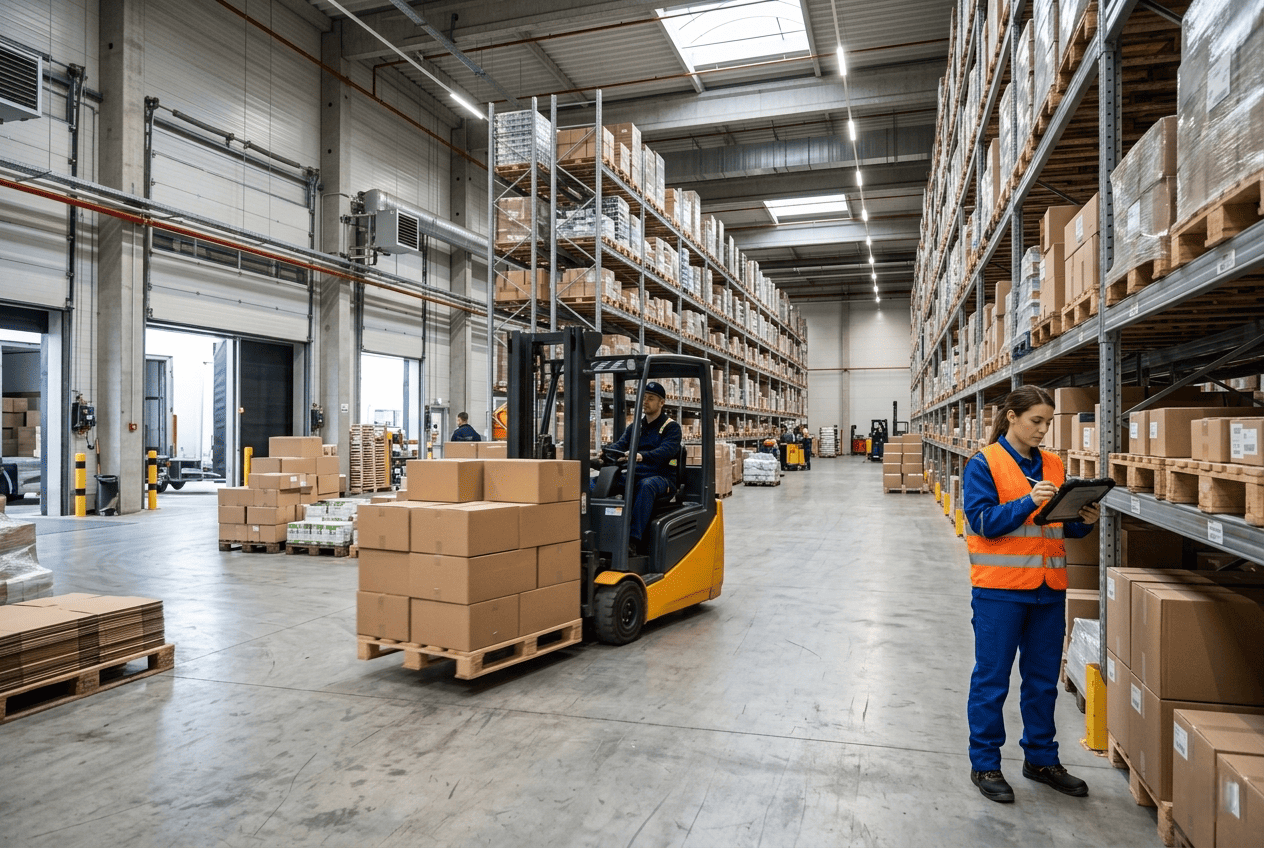
DIR Mensajería has been working since 1990 with companies that need well-coordinated, traceable logistics that are ready to adapt to the reality of their operations. That experience has taught us that many logistics problems do not start at the final delivery, but much earlier: in forecasting, in replenishment, in the lack of stock visibility or in poor coordination with suppliers. That is why we want to clearly explain what procurement logistics involves and why its impact goes far beyond a simple purchase of goods. That is the professional and practical approach with which we handle every project at DIR Mensajería.
What procurement logistics is
When we talk about procurement logistics, we are referring to the set of processes needed to ensure that a company has materials, products or SKUs at the right time, in the right quantity and with the smallest possible margin of error.
It is not just about buying. Good procurement means planning needs, coordinating inbound flows, controlling inventory and avoiding both stockouts and excess immobilized goods.
Put directly: procurement logistics connects purchasing, stock, warehousing and demand forecasting. If that connection fails, the rest of the chain also suffers.
That is why procurement management requires planning and smooth coordination between suppliers, purchasing, warehouse and operations. In addition, within logistics operations, the acquisition of materials, inventory control and stock availability are part of the same workflow.
Why it is key within the supply chain
A company may have good transport and a good warehouse, but if it procures poorly, it will end up working in a rush, with extra costs, delays in dispatch and a much more reactive operation. That is where a large part of inefficiency usually begins.
Logistics does not only cover the final delivery. At DIR we understand the logistics chain as a connected system that includes storage, stock management, order preparation, deliveries and returns.
This means that procurement is not an isolated step. It is a strategic piece that determines product availability, operational continuity and the customer experience.
In our experience, the more aligned procurement, warehousing and transport are, the more control the company gains. Treating them as if they were unrelated processes usually generates delays, duplication and loss of visibility.
Which processes are part of good procurement management
The first process is forecasting. We need to estimate which SKUs will be needed, how often and in what volume, so we are not always reacting too late.
The second is purchasing and supplier management. It is not enough to place orders; you have to coordinate lead times, terms, replenishments and responsiveness when demand changes.
The third is inventory control. Solid procurement needs to know what is available, what comes in, what goes out and what minimum stock level is advisable to maintain for each SKU.
The fourth process is coordination with the warehouse and order preparation. When the company connects inventory, SKUs, ERP, WMS and real operations, it reduces errors and works on a much more reliable basis. At that point, services such as storage, picking or packing stop working separately and become part of the same coordinated operation, from the inbound of goods to their preparation and outbound.
Common mistakes that affect stock, cost and service
One of the most frequent mistakes is procuring without sufficient data. When you buy based on intuition and not on real demand, you end up with excess stock, stockouts and urgent decisions that make operations more expensive.
Another common mistake is not reviewing SKU rotation. Having stock does not always mean being covered; sometimes we have too much of what sells the least and very little of what actually sells.
We also see many issues when procurement is not connected to the warehouse. If inbound flows, locations and replenishments are not well coordinated, the problem ends up affecting order preparation.
On top of that, there is often a lack of smooth relationships with suppliers or systems that are too fragmented. The lack of information exchange, metrics and follow-up makes decision-making more difficult and keeps the business operating in constant corrective mode.
How to improve procurement logistics with data and technology
Improving does not always mean making things more complex. Very often real progress starts with having clear visibility of inventory, stock movements and replenishment lead times.
Integrated systems help with exactly that. When purchasing, inventory, warehousing and transport share information, manual errors are reduced and the ability to anticipate increases.
At DIR we attach great importance to this part because traceability and data enable better decision-making. Technology does not replace operational judgment, but it does make it more precise and more useful.
In addition, when we have real-time tracking, dashboards and integration with platforms and management systems, we can detect issues earlier and organize the entire chain better. On the DIR blog we share practical content on operations, warehousing and technology applied to logistics.
What changes when the business sells online or grows fast
In an ecommerce business or in a company with accelerated growth, procurement stops being an administrative task and becomes a critical service factor. A stock mismatch can translate into lost sales, delays and issues with customers.
When volume increases, complexity and the need for synchronization also grow. Catalogue, stock, orders, replenishment and order preparation must operate as a coordinated system.
That is why good procurement management becomes even more important in digital environments. If there is no connection between the store, inventory and operations, it is very easy to sell unavailable SKUs or work with outdated information.
At DIR we work on this integration in our ecommerce logistics solutions: stock synchronization, connection with ERP and WMS, centralized control and the ability to handle demand peaks without losing efficiency.
When it makes sense to rely on a specialized logistics operator
There comes a time when managing procurement only with internal resources starts to generate more friction than control. This usually happens when SKUs, orders, returns or activity peaks increase.
At that point, outsourcing does not mean losing visibility. When properly designed, it means gaining access to more orderly processes, specialized technology, optimized facilities and teams used to operating with traceability.
In addition, when the same operator connects storage, preparation and distribution, communication is simplified and intermediaries are reduced. That helps transform reactive logistics into much more stable logistics. Having well-structured operations can make a real difference in efficiency and traceability. At DIR Mensajería we understand that good procurement logistics should provide peace of mind, not create more internal workload. If you need to review your operations or business, improve stock control or better coordinate warehouse and service, you can contact us and we will study your case with a truly practical and personalized approach.


