


At DIR Mensajería we have been working for more than three decades as a transport agency in Barcelona for companies that need more than just moving parcels from one point to another: they need control, punctuality, traceability and an operation capable of adapting to their real pace. Our experience in courier services, transport, warehousing, picking, packing, eCommerce and reverse logistics allows us to understand logistics from the inside, with its urgencies, its incidents and its opportunities for improvement. That is why, when we talk about sustainability, we do not do it from theory, but from the daily practice of a company that knows how each logistics decision impacts costs, the end customer and the environment: DIR Mensajería.
What is green logistics and why does it matter more and more?
Understanding what green logistics is means looking at logistics with a broader vision. It is not just about delivering fast, but about doing it in a more efficient, responsible and sustainable way.
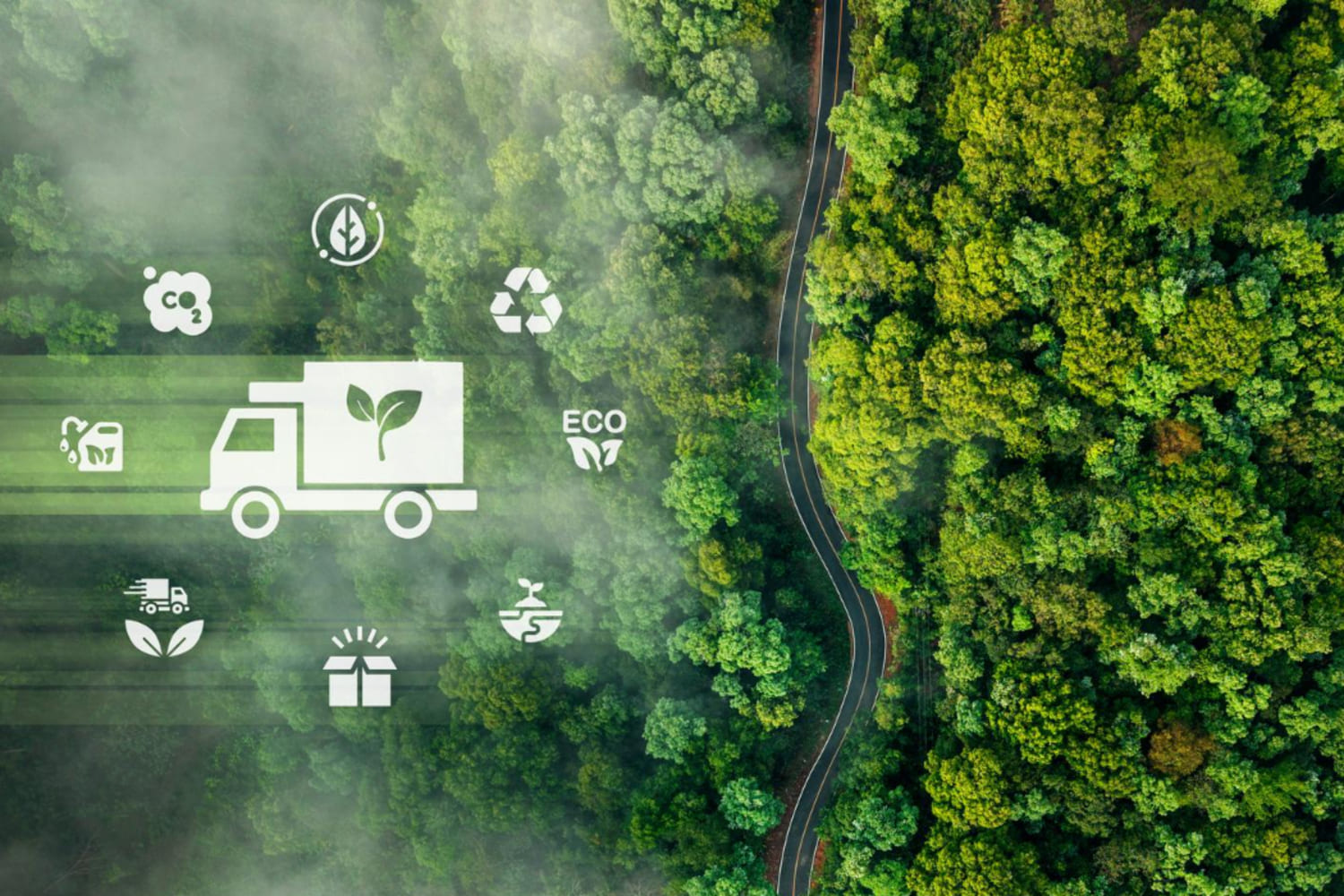
Green logistics seeks to reduce the environmental impact of all phases of the process: logistics warehousing, order preparation, packaging, transport, distribution and returns management.
This includes very specific decisions, such as optimizing routes, avoiding unnecessary trips, improving vehicle load factor, reducing inefficient packaging or opting for less polluting means of transport.
For a company, applying this approach not only improves its environmental responsibility. It can also help reduce costs, streamline processes and offer a more coherent experience to customers who are increasingly attentive to how they buy and who delivers to them.
Green logistics does not start with transport
Sustainability in logistics is often associated only with electric vehicles or bicycle deliveries. These are important elements, but the concept goes much further.
A poorly organized operation can generate more emissions even if it uses good vehicles. If there are preparation errors, failed deliveries, duplicated routes or poorly managed returns, the impact multiplies.
That is why, before talking about delivery, we must review how goods are stored, how order preparation is handled and how the dispatch of goods is coordinated.
From our experience, more sustainable logistics starts with well-designed processes. The less improvisation there is, the fewer incidents arise and the fewer resources are wasted.
What is green logistics when applied to a real company?
When a company asks itself what green logistics is, the answer must be brought down to earth. It is not enough to say “be more sustainable”; it is necessary to understand which specific actions can be applied in day-to-day operations.
For example, an online store can reduce picking errors, choose more suitable packaging, group shipments or better manage returns to recover products in good condition.
A company with urgent shipments can improve route planning, choose the right vehicle according to volume and distance, or avoid oversized services when they are not necessary.
In both cases, sustainability does not compete with efficiency. On the contrary: well-designed green logistics is usually more organized, more profitable and easier to control.
Route optimization: fewer kilometers, more efficiency
One of the key points of green logistics is route optimization. Every unnecessary kilometer means more consumption, more time, higher cost and more emissions.
Better delivery planning makes it possible to reduce duplicated routes, adjust schedules and use the most suitable means of transport according to urgency, area and type of goods.
In urban environments, for example, it does not always make sense to use a van. For certain local shipments, solutions such as bicycles, motorbikes or walking delivery can be more efficient.
On national routes or those with higher volume, the key is to consolidate loads, coordinate departures and avoid poorly utilized transport. Sustainability is also achieved with data, planning and operational sense.
Packaging, picking and packing: sustainability before delivery
Packaging has more impact than it seems. A poorly protected parcel may end up damaged, returned or resent, which generates more waste, more transport and higher costs.
That is why packing should not be seen only as a final task before dispatch. It is a strategic part of the customer experience and logistics efficiency.
The same happens with picking. Poor order preparation leads to returns, complaints and new shipments. Every logistics error has an environmental and economic consequence.
Green logistics requires accuracy in the warehouse, packaging tailored to the product and verification processes that reduce errors before the order leaves for the recipient.
Reverse logistics: the major challenge of returns
In eCommerce and retail, returns are one of the most complex points. If they are not managed properly, they generate costs, overload teams and increase unnecessary movements.
Reverse logistics makes it possible to organize this process: collecting, sorting, inspecting, refurbishing, recycling or redistributing products according to their condition.
Here sustainability has a very clear role. Recovering usable goods, reducing waste and avoiding disorganized transport helps improve profitability and environmental impact.
That is why, when talking about what green logistics is, we cannot focus only on delivery. We must also look at what happens when the product comes back and how that return is integrated into operations.
Technology and traceability to make better decisions
You cannot improve what you do not measure. That is why technology is a direct ally of green logistics.
Having traceability makes it possible to know where each shipment is, detect incidents, analyze times, review routes and improve processes with real information.
For a company, this translates into fewer calls, less uncertainty and greater responsiveness to customers, internal teams or campaigns with a high volume of orders.
Sustainability does not depend only on good intentions. It depends on systems that make it possible to work with control, anticipate problems and adjust operations when something is not working.
How to start implementing more sustainable logistics?
The first step is not to change everything at once. The smartest move is to review where most incidents, costs or unnecessary movements occur.
It may be in the warehouse, in order preparation, in packaging, in failed deliveries, in returns or in the lack of coordination between suppliers.
From there, it is advisable to prioritize specific improvements: more efficient routes, better-sized packaging, safer picking processes or more organized reverse logistics.
This is how we understand what green logistics is from a practical point of view: not as a label, but as a way of working better, reducing waste and building an operation that is more prepared to grow.
Do you want your logistics to work in favor of your growth?
If after understanding what green logistics is you have realized that your processes can improve, it is time to act.
We can help you transform your operation into a more efficient, traceable system that is ready to scale. We integrate warehousing, picking, packaging, transport and local courier or national courier solutions under a single logistics strategy, with personalized attention and solutions adapted to your volume and sector, with personalized attention and solutions adapted to your volume and sector.
Logistics should not create incidents for you or slow down your growth. It should give you control, peace of mind and competitive advantage.


